

ETS Training material
At the core of ETS are the victim banks. The trauma victim banks consist of patients who can be managed throughout the entire chain of care, from the incident site to the hospital. All trauma patients are accompanied by individual management cards.
Below is description of version 5 and version 4 of the ETS victim banks. In version 5, all victim banks and patient outcome categorieshave undergone a medical review. Another difference is the adding of X – Exsanguinating hemorrhage, new layout and added Ward time on the management card.
Trauma patient – version 5
Each patient symbol contains information on both the front and the back.
The front provides information that can be observed or heard from a distance before the patient is examined. For example, the patient may be lying down and quiet. The back provides information identified during the patient examination.
The information is structured according to the ATLS®/PHTLS®/TNCC® approach:
- X – Exsanguinating hemorrhage
- A – Airway
- B – Breathing
- C – Circulation
- D – Disability
- E – Exposure
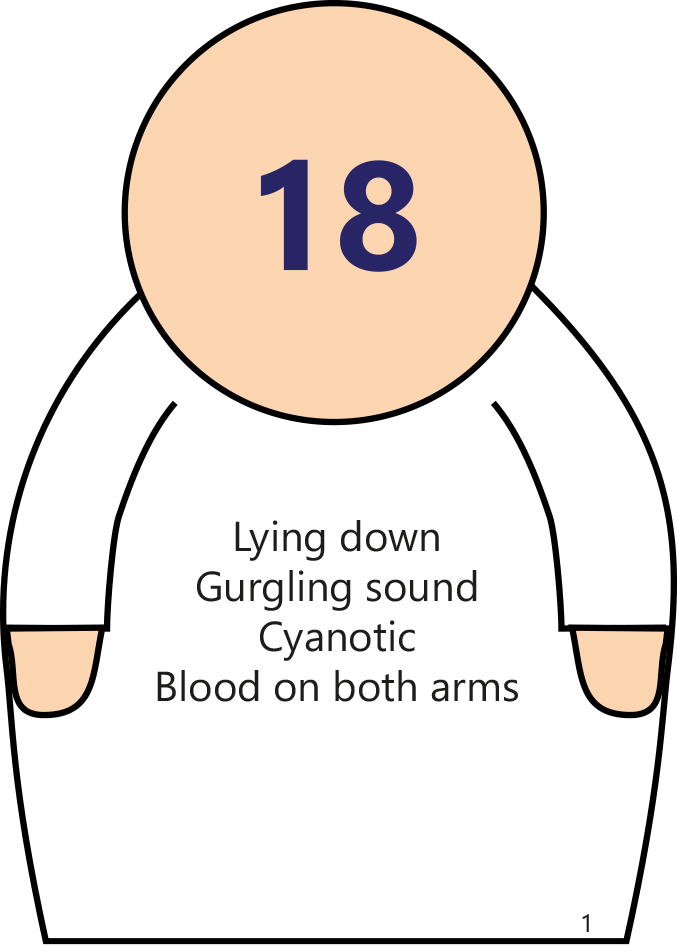
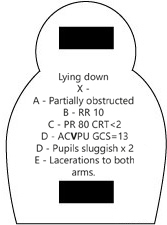
Management card – version 5
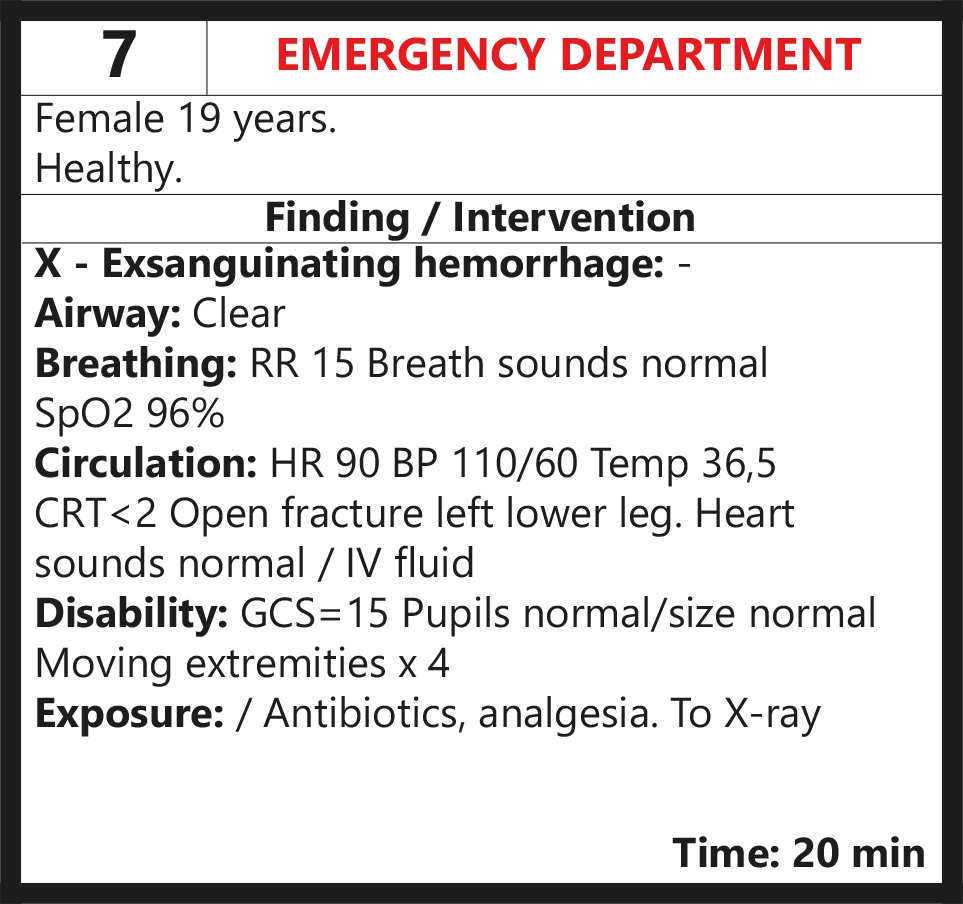
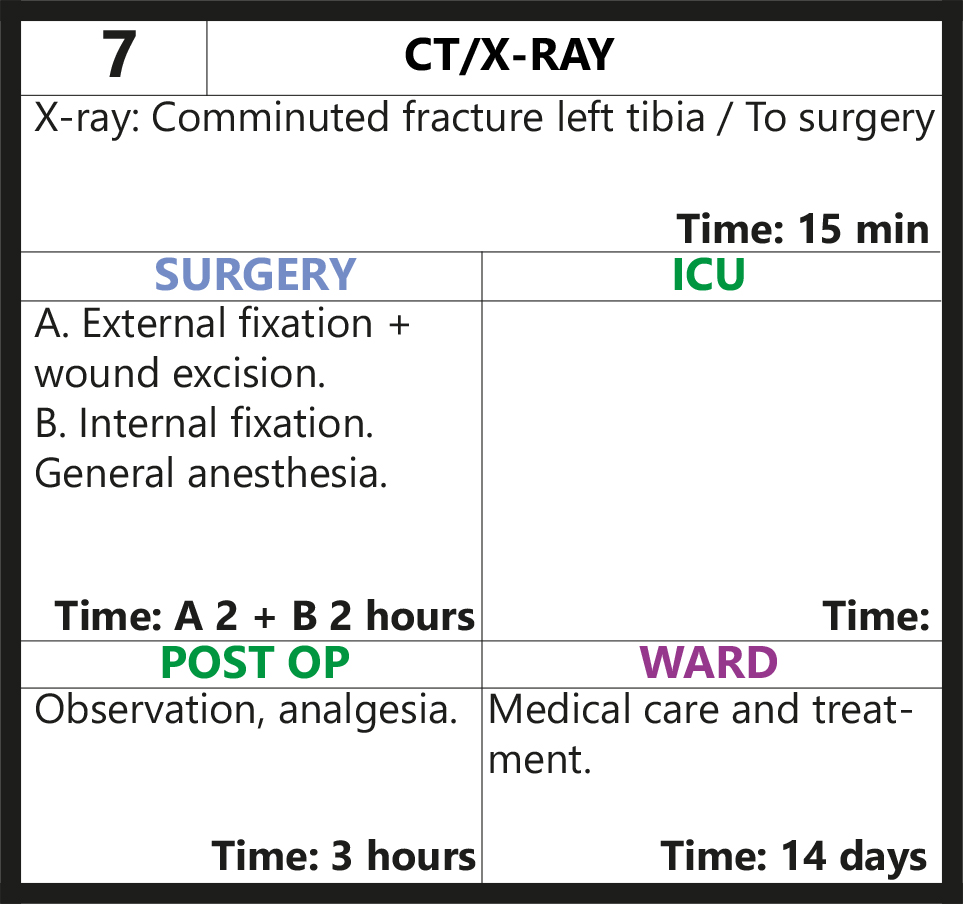
All patients in the trauma victim banks have an individual management card, which is used when the patient arrives at the hospital.
The front of the card provides information about the treatment or treatments required in the Emergency Department and the time needed to perform them.
If a patient is sent to CT/X-ray, the information about CT/X-ray findings and the time required in the radiology department is available on the back side of the card. If the patient requires surgery or admission to the Intensive Care Unit (ICU), this information is provided on the back of the management card. The card also specifies the required time in post-operative care and also time on Ward department.
All victim banks include a document (on USB to print) showing the estimated rehabilitation time for each patient.
Patient outcome – version 5
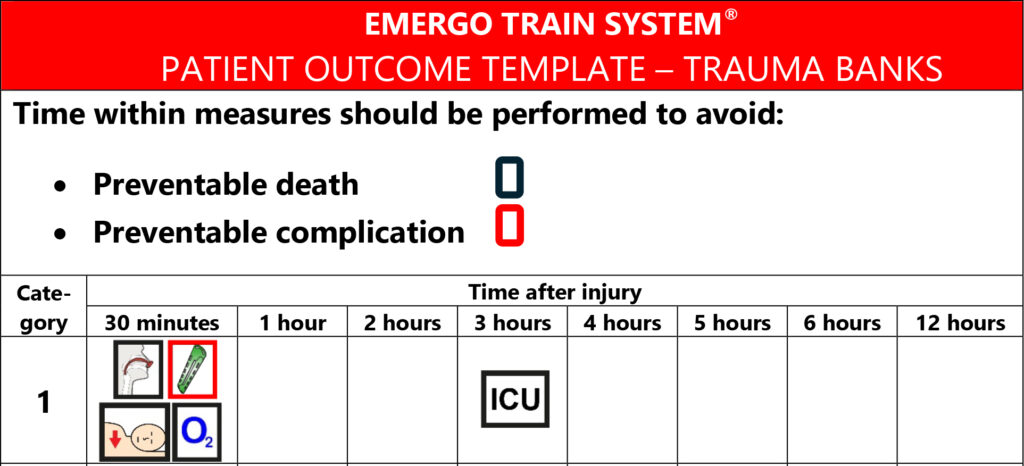
All ETS patients are assigned to different patient outcome categories. Depending on which interventions are performed and how soon they are carried out after the injury occurs, the patient may be at risk of a preventable complication or preventable death. In version 5, the patient outcome categories have undergone a medical review and been updated.
A patient outcome template is included with all trauma victim banks.
Trauma patient – version 4
The patient has text on both the front and back side. On the front side is information that you can see or hear from a distance. For example, the patient is lying down and is quiet. On the back is information that you discover after examining the patient. This text is in accordance with the ATLS®/PHTLS®/TNCC® program; A=Airway, B=Breathing, C=Circulation, D=Disability, and E=Exposure.


Management card – version 4
All victims in the victim bank have an individual management card. The card is used when they arrive in the hospital. On the front page is information about the treatment(s) the patient is given in the Emergency department and the time it will take. Also included is a description of CT/X-ray result and time at X-ray department.
If the patient needs surgery or ICU this information is provided on the back side of the management card where you also can find time at Post-op.


Patient outcome – version 4
All ETS patients are categorized into different patient outcome categories. Depending on what intervention is made and within what time after the injury, the patient risk preventable complication or preventable death. The patient outcome template is included in all trauma victim banks.

Available Victim banks
There are several different victim banks to choose depending on what exercises to conduct. All victim banks includes patient outcome template and templates to sort out patients from the victim bank based on patient outcome category. Some victim banks also include extra treatment stickers.
Some victim banks are available in both versions 4 and 5, while others are only available in version 4.
Trauma victim bank – version 4 and 5
The Trauma victim bank contains patients with a wide range of general traumatic injuries.
Available in three sizes:
- Large: 200 patients (1–200)
- Medium: 100 patients (1–100)
- Small: 50 patients (1–50)
Burn trauma victim bank – version 4 and 5
The Burn trauma victim bank consists of patients with varying degrees of burn injuries/smoke inhalations. It is designed for simulation exercises involving incidents that result in multiple patients with burn injuries.
The bank also includes stickers for specific interventions, including positioning the patient in a sitting position and performing an escharotomy.
Available in two sizes:
- Medium: 100 patients (401–500)
- Small: 50 patients (401–450)
Penetrating trauma victim bank – version 4 and 5
The Penetrating trauma victim bank consists of patients with varying degrees of penetrating trauma, for example injuries caused by gunshots or stab wounds.
These injuries require specific interventions to be performed by the appropriate medical resource within a defined time frame calculated from the time of injury.
In addition to other patient outcome categories, the Penetrating trauma victim Bank includes:
- 23 – Penetrating thoracic injury
- 24 – Penetrating neck injury
- 25 – Severe extremity bleeding
Additional sheets of treatment stickers are included in the Penetrating trauma victim bank.
Available in two sizes:
- Medium: 100 patients (501–600)
- Small: 50 patients (501–550)
Bomb/blast trauma victim bank – version 4 and 5
The Bomb/Blast trauma victim bank consists of patients with blast-related injuries, such as crush injuries, vascular injuries, contusions and intestinal injuries.
It can be used in exercises involving scenarios such as terrorist attacks, armed conflicts and accidents involving explosions.
The patients include primary, secondary and quaternary blast injuries related to their distance from the source of the explosion. The bank includes most of the standard ETS patient outcome categories, from categories 1 to 25.
Available in two sizes:
- Medium: 100 patients (701–800)
- Small: 50 patients (701–750)
Pediatric trauma victim bank – version 4
Consists of pediatric patients, from infants up to 17 years old, with different trauma injuries such as for example crush injuries, penetrating injuries, vascular injuries, contusions, intestinal injuries, different types of fractures and wounds.
The pediatric trauma victim bank can be used as a complement to other ETS victim banks when you need pediatric vitims to a scenario. The victim bank can also be used to conduct surge capacity exercises at children hospital.
The time within measures should be performed to avoid preventable death or complication is lower for children and depends on the age of the child. The pediatric patient outcome categories are the same as for adults, but have subcategories depending on the age of the child. A pediatric category start with P in front of the category number and the subcategories are a, b and c. Category P-a are children 0-1 year, P-b are children 2-4 years and P-c children 5-12 years. Children over 12 years are evaluted according to adult categories. There is a special template for pediatric patient outcome evaluation included in the victim bank. There are also templates to sort out patients from the victim bank based on patient outcome category or age.

Available in medium 100 patients (601-700) and small 50 (601-650) patients.
Uninjured/psychological shock victim bank – version 4 and 5
During a pre-hospital incident exercise, it may be useful to include people who have no physical injuries and/or are experiencing psychological shock.
These individuals are triaged as green at the incident site and do not require medical treatment at the scene or in hospital. Therefore, they do not have management cards. However, they may still require resources, such as transportation.
Available in two sizes:
- Medium: 50 patients (301b–350b)
- Small: 25 patients (301b–325b)
Trigger victim bank – version 4 and 5
The Trigger victim bank can be used by the ETS instructor to introduce additional patients during an exercise. These patients are not casualties from the incident itself. Instead, they may arrive by ambulance or come from another department within the hospital.
All trigger patients are identified with the letter T and can be used as exercise injects. For example, if instructors want to increase the workload on a hospital during an exercise, they can introduce additional trigger patients arriving by ambulance.
Trigger patients have management cards and require assessment and treatment in the same way as other ETS patients.
They are categorized using the same principles as other patients. Some trigger patients are assigned patient outcome categories and are evaluated using the patient outcome template. Others have in-hospital evaluation outcomes and are assessed using the in-hospital patient evaluation.
Available in one size:
- 50 patients (T1–T50)
Figurant cards – version 4
The ETS figurant cards can be used when conducting pre-hospital exercsies using figurants acting injured. The cards can also be combined with an exercise using ETS magnetic patients.
The front side of the figurant card illustrates what the medical staff see and hear on a distance before examining the patient. The back side of the card illustrates the information the medical staff will find when examine the patient. On the back side is also a photo of the injury and also instructions for the figurant of how to act.

All the figurant cards are based on the data in the Emergo Train System version 4 trauma bank and each figurant card corresponds to a magnetic symbol. This makes it possible to continue an exercise from a pre-hospital exercise using figurants, to an in-hospital setting using magnetic patients and whiteboards. Simply transfer the measures made on the figurant to the magnetic patient by adding stickers on the patient symbol! Patient outcome can then be evaluated all the way from incident site in to hospital.
Available in medium (trauma patient 1-100) and small (trauma patient 1-50).